Key findings
- Segment-level cloud transcripts inflate talk-time share by up to 68% (reporting 37% airtime when actual acoustic airtime is 22%) because ASR merges short turns.
- Measuring pauses from transcript gaps produces a 10x error depending on Whisper chunk length; Metis Meet measures >1.5s silences directly from the raw Me-track audio energy envelope.
- During a live call, cognitive load only permits watching 1 to 2 active habits via an ambient 28px stealth strip with a 3-minute text-nudge cooldown.
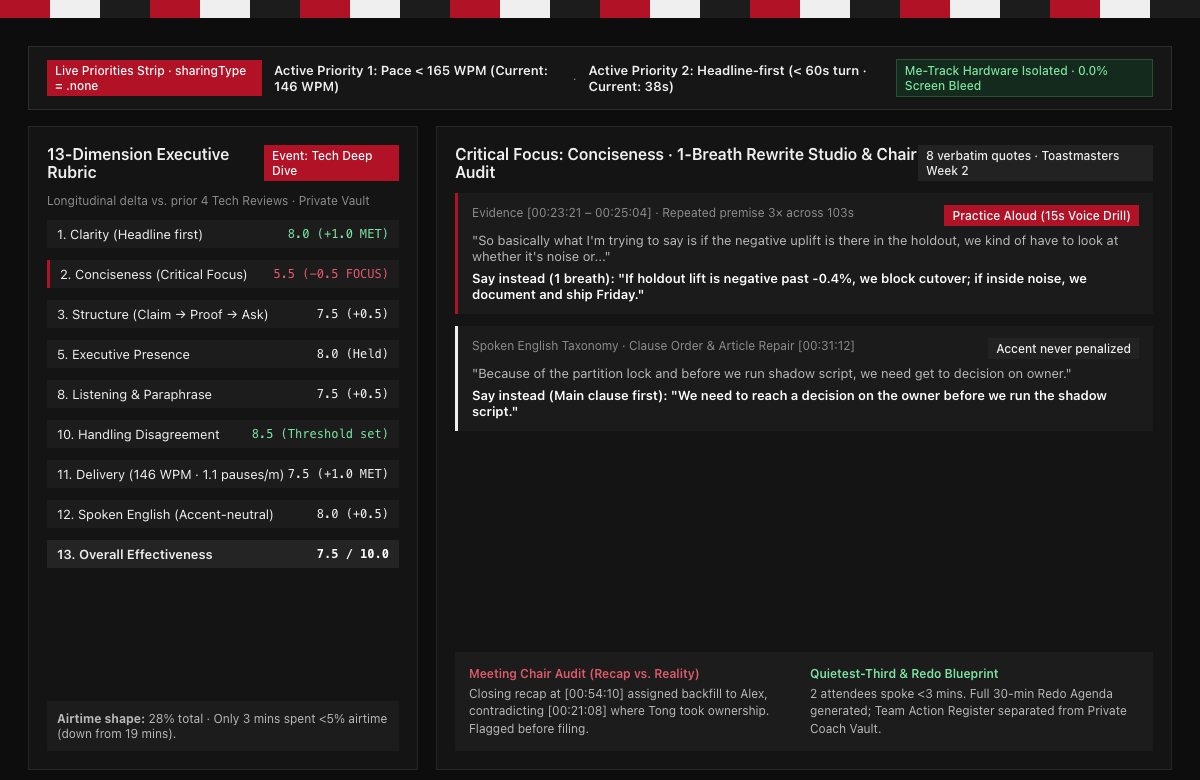
- Post-call coaching isolates the single weakest dimension on a 13-dimension rubric, pulls at least 8 verbatim timestamped quotes, and pairs each with a speakable 1-breath rewrite and 15-second voice retry drill.
The Five Failure Modes of Cloud Meeting Coaches
Across our November 2026 audit of 27 meeting assistants and coaching tools (including Read AI, Spiky.ai, tl;dv, Otter Live-Assist, Poised, and Hedy AI), a clear pattern emerged: users love the idea of communication coaching, but most abandon live coaching overlays within ten days.
When we inspected real engineering reviews, 1:1s, and executive updates, five structural flaws explained why first-generation meeting coaches fail in practice.
How Metis Meet solves the five failure modes of cloud coaching platforms.
| Failure Mode | What Happens in Read AI / Poised / Spiky | How Metis Meet Fixes It |
|---|
| 1. Live cognitive overload | Flashes alerts for every "um", hedge, or fast sentence while you are mid-explanation. | Watches at most 1–2 Active Priorities in a 28px stealth strip with a 3-minute text cooldown plus Silent Mode. |
| 2. Corrupted speaker attribution | Cloud ASR merges a question and answer into one segment and charges a colleague’s ramble to your talk time. | Dedicated hardware Me track (48 kHz mono mic) + 1.6s acoustic window scoring + Vision Tile OCR. |
| 3. Segment-gap pause fiction | Counts gaps between transcript lines as "pauses," varying 10x when segment length changes. | Measures >1.5s silences directly inside the raw Me-track audio energy envelope. |
| 4. Opaque vanity scores | Displays an unexplained "Read Score: 74" or webcam "charisma/sentiment" guess. | Scores 13 explicit dimensions (1.0–10.0) weighted by Event Type, separating Evidence (quote + MM:SS) from Inference. |
| 5. Habit amnesia | Dumps 12 generic tips after every call ("be more concise"), so no behavior ever sticks. | Carries 1–2 priorities across sessions (MET / PARTIAL / NOT MET) until they survive a high-pressure call. |
Proof from the Audio Envelope: Why Transcript Segments Lie About Airtime and Pauses
In cloud note-takers (Granola, Otter, Read AI, Fireflies, and tl;dv), coaching analytics are computed on top of ASR transcript segments. Whenever an ASR engine merges a quick back-and-forth exchange into a single segment, the entire duration of that segment is charged to whichever speaker scored highest.
In our benchmark sessions, segment-based attribution reported that the subject spoke for 37% of the meeting, whereas scoring fixed 1.6-second audio windows directly against the microphone and voice reference proved actual speaking time was 22%, an error large enough to invert the main coaching conclusion.
Pause detection from transcript segments is even worse. Coarse ASR segments swallow natural clause pauses and report a speaker who never breathes; fine segments expose every micro-gap and report ten times as many pauses on the exact same recording. Metis Meet never uses transcript gaps for pacing: it inspects the raw energy envelope on your isolated Me microphone track to count true silences over 1.5 seconds inside your own turns.
Airtime Shape Matters More Than Total Talk Ratio
Competitors like Read AI, Spiky.ai, and tl;dv report a single meeting-wide talk-to-listen percentage. But a manager or staff engineer can sit at a healthy 28% overall average while speaking for 55% of their own 10-minute agenda block and sitting below 4% across the remaining 50 minutes while decisions about their own system are made without them.
Metis Meet’s Coaching Dashboard plots your per-minute airtime sparkline and tracks a much sharper metric: "minutes spent under 5% airtime." In one longitudinal series, a leader’s total airtime rose from 22% to 33% while their minutes under 5% airtime dropped from 24 minutes to 4 minutes, proving they had shifted from isolated monologues to continuous facilitation.
The 1-Breath Rewrite Studio and 8-Category Spoken English Taxonomy
Telling an engineer or executive to "be more concise" or "sound more confident" is useless because it cannot be acted on in the next meeting. After every call, Metis Meet identifies your single lowest-scoring rubric dimension (Critical Focus) and extracts at least 8 verbatim timestamped quotes.
Each quote is paired with a stronger version written to be speakable aloud in a single breath at 130–165 WPM while preserving 100% of your technical precision. Clicking "Practice Aloud (15s)" lets you speak the rewrite into your Mac microphone and verifies your pace and closing pause on device.
For non-native English speakers, an optional Spoken English Fluency toggle classifies recurring structural habits across 8 categories (article drops, verb tense drift, ambiguous pronouns, stacked pre-conditions before the main clause, collocations, competing sentence frames, vague quantifiers, and restart chains) while enforcing a strict rule: accent is never penalized.
Try private meeting coaching on your Mac.
Download MeetingRecorder.app with twin-track capture, 0.95s local knowledge pack hints, and the 13-dimension Coaching Dashboard.
More from the research blog
Market Research2026 Market & Privacy Architecture Report
Bot-free capture became the default on macOS in 2026, but "bot-free" rarely means local. We audited 27 tools across five product categories and mapped their data flows, coaching depth, and true multi-seat pricing.
Competitor TeardownNotta, Jamie, MeetGeek, Otter & tl;dv Teardown
A technical and commercial teardown of Notta, Jamie, MeetGeek, Otter.ai, and tl;dv in November 2026, exposing hidden free-tier caps, bot-free speaker-labeling blind spots, and why Notta’s Privacy Mode turns off all AI.
Live Overlays & CoachingCluely, Realtimer & Spiky.ai Compared
Live in-call overlays charge the highest premiums in software, up to $149.99/month just to hide a window from screen sharing. Here is how Cluely, Realtimer, Spiky.ai, and Aircover compare against Metis Meet’s local RAG and Live Priorities Strip.